
Seven mode-specific RTP figures
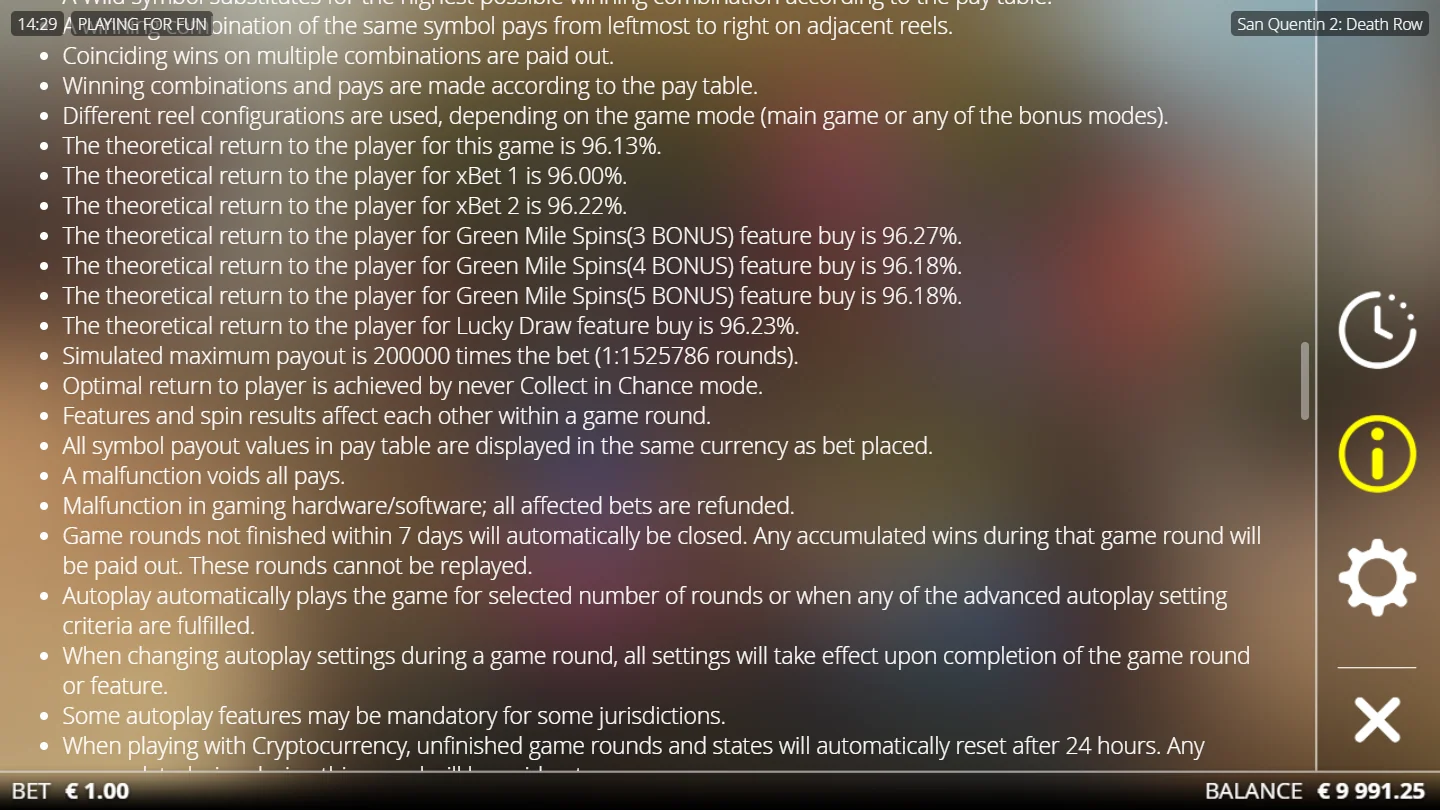
San Quentin 2 does not have one percentage that can be attached uncritically to every priced action. The rules delivered with our demo list seven mode-specific theoretical returns. The ordinary game is 96.13%, while the highest listed figure is 96.27% for the three-Bonus direct entry. All seven are below 100%.
The percentages describe theoretical return relative to the amount staked under the relevant game conditions. They do not mean that each €100 session returns a predictable €96, or that a short session must recover toward that figure. A volatile game can produce long stretches of small returns and occasional much larger payments. The distribution matters as well as its average.
| Mode | Cost × base | Configured RTP | Theoretical shortfall per €100 turnover |
|---|---|---|---|
| Ordinary | 1× | 96.13% | €3.87 |
| xBet 1 | 2× | 96.00% | €4.00 |
| xBet 2 | 45× | 96.22% | €3.78 |
| 3 Bonus | 100× | 96.27% | €3.73 |
| 4 Bonus | 500× | 96.18% | €3.82 |
| 5 Bonus | 2,500× | 96.18% | €3.82 |
| Lucky Draw | 740× | 96.23% | €3.77 |
The final column is arithmetic: €100 multiplied by one minus the stated RTP. It is not a measured loss from our sample or a charge added to every bet. A person can lose the complete stake on a particular round or receive more than that stake. The table compares theoretical averages on equal turnover, not the price of one click.
Equal turnover is the crucial qualification. At a €1 base stake, an ordinary spin exposes €1 while a five-Bonus purchase exposes €2,500. Choosing a slightly higher percentage can still mean committing much more money to a single outcome. Compare complete cost first, then the mode’s rules and percentage. The bonus-buy guide shows the exact menu prices.
Chance changes the interpretation of optimal play
The game explicitly states that optimal return is achieved by never choosing Collect in Chance mode. This is a game-specific choice within a feature, not a generic claim that “all slot choices are cosmetic”. Omitting it would leave a player with an incomplete explanation of the listed optimal return.
Chance offers an additional Jumping Wild at the stated risk of losing five spins. The number of Wilds affects active Enhancer reels; the fourth and fifth awarded Wild begin with 2× multipliers. At five Wilds, a further choice can be for the maximum win against losing five spins. These changes affect the feature state before it settles.
Optimal theoretical return is different from a promise that gambling the award will improve this particular bonus. A choice with the better average can have a worse outcome on a given attempt. Keeping an award may serve a preference for avoiding that immediate gamble, but it should not be described as the policy that maximises the game’s stated theoretical return.
The actual probabilities of individual Chance draws were not established in our capture. We do not assign them 50/50 odds simply because two outcomes are visible. Nor do we calculate a personalised expected profit from unknown draw probabilities. The verified statement is the rule the client publishes, with its uncertainty kept intact.
This distinction also prevents an attractive but misleading strategy headline. “Always gamble for guaranteed profit” would be false. “The rules identify an optimal Chance policy, but the overall RTP remains below 100%” is the supported conclusion. That is useful information without turning a mathematical qualification into a winning-system claim.

What our ten completed rounds show
We recorded ten sequential ordinary demo rounds at a fixed €1 stake. Each completed response was matched to its action and its balance change. The total cost was €10, total return €1.25 and net result −€8.75. Four rounds paid something back, but none returned as much as its €1 cost.
The returns, in order, were €0, €0, €0.20, €0, €0.20, €0.65, €0, €0.20, €0 and €0. The largest return was therefore €0.65, not a profitable spin. This is a concrete example of the difference between a hit and a net win. A game can celebrate a symbol payment while the complete round still reduces the balance.
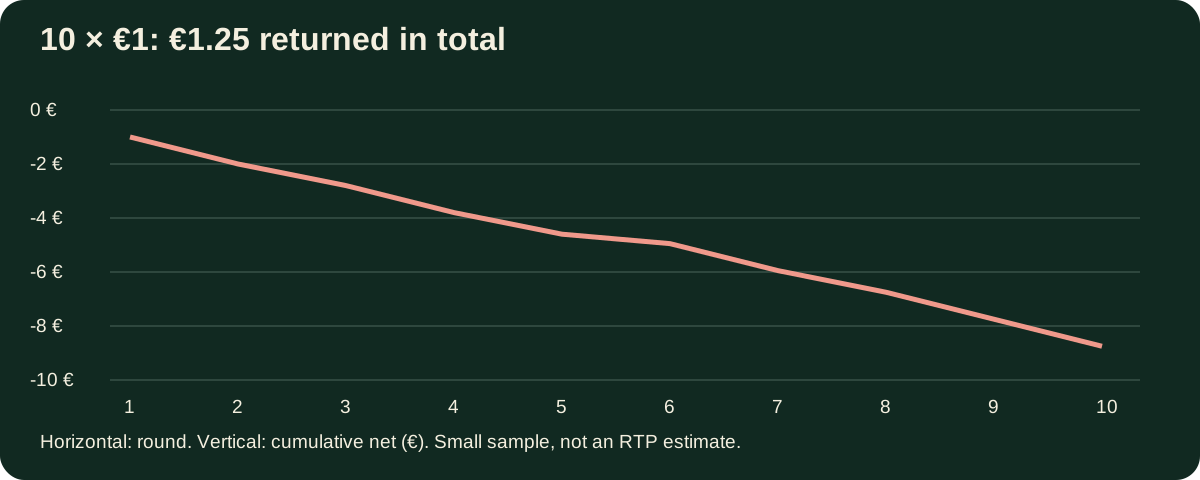
Dividing €1.25 by €10 gives a 12.5% observed return for these ten spins. That calculation is valid for the recorded slice, but calling it the slot’s actual long-run RTP would be misleading. Ten starts contain very little information about rare large features, and no natural free-spin feature occurred here.
A separately attempted €100 feature purchase returned SessionException 1007 without a settled game response. The client briefly showed a lower balance, but that is not enough to classify a loss. We quarantined the attempt and did not add it to the ten-round totals. There is no successful bonus replay hidden behind the ordinary-round result.
The short sample supports illustrated observations about controls, ways and accounting. It does not support a confident ranking of betting systems. The complete round table makes the individual costs and returns visible, including the unconfirmed attempt’s separate status.
Five strategy questions with practical answers
1. Does doubling after a loss fix the sample?
No recorded ordinary round returned even one times its stake. Replaying those same return ratios with larger positive stakes would still make each placed bet negative; skipping every bet would merely produce zero. This is a statement about these ten recorded ratios, not proof that every possible future sequence loses. It also means there is no honest profitable parameter set to advertise from this slice.
A doubling system increases exposure precisely after losses. At a €1 starting amount, six consecutive placed bets of €1, €2, €4, €8, €16 and €32 cost €63 in total. The next requested amount would be €64. This hypothetical stake sequence does not alter symbol probabilities or guarantee that a future return covers all earlier costs.
2. Does waiting several rounds create an advantage?
Waiting reduces the number of paid starts you make during the observation window. It does not establish that the next independent paid start is due to trigger Green Mile Spins. We did not observe a predictive relationship between separate rounds. The fact that internal feature states persist is a different rule from a losing-streak signal across completed games.
3. Is the highest RTP mode always the cheapest choice?
No. The 96.27% three-Bonus entry has the highest percentage in this captured list, but costs 100 base stakes. At a €1 base stake, its theoretical shortfall for a €100 entry is €3.73 under the stated assumptions. The ordinary €1 start has a theoretical shortfall of €0.0387. Those figures are average-model calculations, not fixed fees or predicted outcomes.
4. Do stop-loss and take-profit rules change the game?
They change when you stop placing further bets. That can be useful for limiting session exposure, but does not rewrite the payout table or turn the completed losing rounds into winning ones. A historical session ending above its starting balance is an observed endpoint. It is not evidence that the same stop settings produce positive expectation on fresh play.
5. Can faster spinning improve the odds?
The client supports faster animations, but our capture supplies no evidence that speed improves the outcome distribution. Faster controls can increase how many paid starts occur in a period. Separate the convenience of the interface from the financial exposure of repeated actions. For learning, a slower view makes transformations and complete cost easier to follow.
Hit frequency, bonus frequency and the maximum
The provider publishes a 26.90% hit frequency and a free-bonus frequency of one in 299. A hit is not necessarily a profitable round, as the €0.20 and €0.65 payments in our sample demonstrate. The bonus-frequency figure is an average specification, not a countdown that guarantees a feature by spin 299.
The delivered configuration gives a simulated maximum payout of 200,000× and a maximum-payout frequency of 1:1,525,786 rounds. The provider’s public page rounds that description to about one in 1.5 million. Neither is a frequency measured by our ten spins. The number describes a modelled rare event and should not be treated as a realistic session target.
The maximum is based on the base stake. At €0.20 that arithmetic cap is €40,000; at €1 it is €200,000. It is not the feature purchase price multiplied by 200,000. Reaching the cap ends Green Mile Spins under the No Escape rule, so remaining animated possibilities do not create an award above that stated cap.
A normal bell curve is not a good picture of these ten payouts or of a slot with a hard zero floor and a very large rare upper tail. We have not estimated the full distribution, variance or a confidence interval from this tiny sample. Publishing a smooth curve without enough observations would make the evidence look stronger than it is.

For detailed readers: what the client exchange confirms
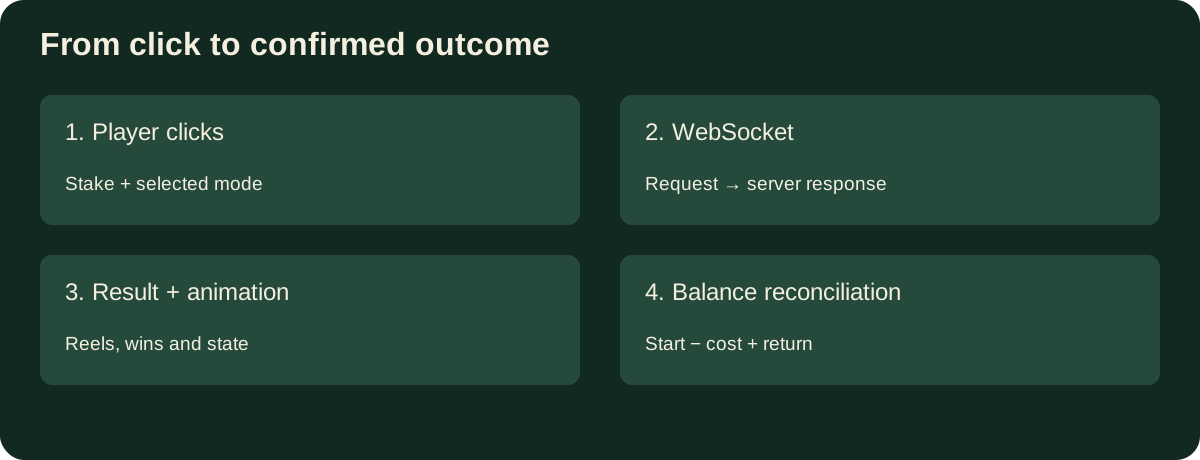
The official demo used a WebSocket connection for game actions. Incoming messages were compressed with an LZW-labelled format; decoding the observed client format exposed reels, total ways, mode transitions, feature counters, return and balance fields. Static artwork and rules loaded separately. These observations describe the public client we used, not an audit of the operator’s entire infrastructure.
For the ten sequential ordinary actions, we measured the interval from the browser’s sent frame to the corresponding received frame. It ranged from 80.9 to 123.0 milliseconds, with a median of 84.0 milliseconds. This includes network travel and server handling. It is not ICMP ping, one-way latency or a benchmark measured from a Finnish player’s connection.
The response carries game state as well as money values. That matters because a free-spin child result is not automatically a new paid bet. We checked the ordinary rounds’ NORMAL-to-NORMAL state and reconciled start balance minus cost plus return with end balance. The feature attempt supplied an error instead, so no final outcome was inferred from its animation.
Our configuration was labelled DEFAULT and used EUR practice credits. The game build was 1.1.28-battlenopixi.9. Neither label establishes a Finnish licence, a particular operator’s RTP or partner availability. The site’s demo instructions and cost calculator keep those questions separate from the mechanics.
How one result can be checked from its numbers
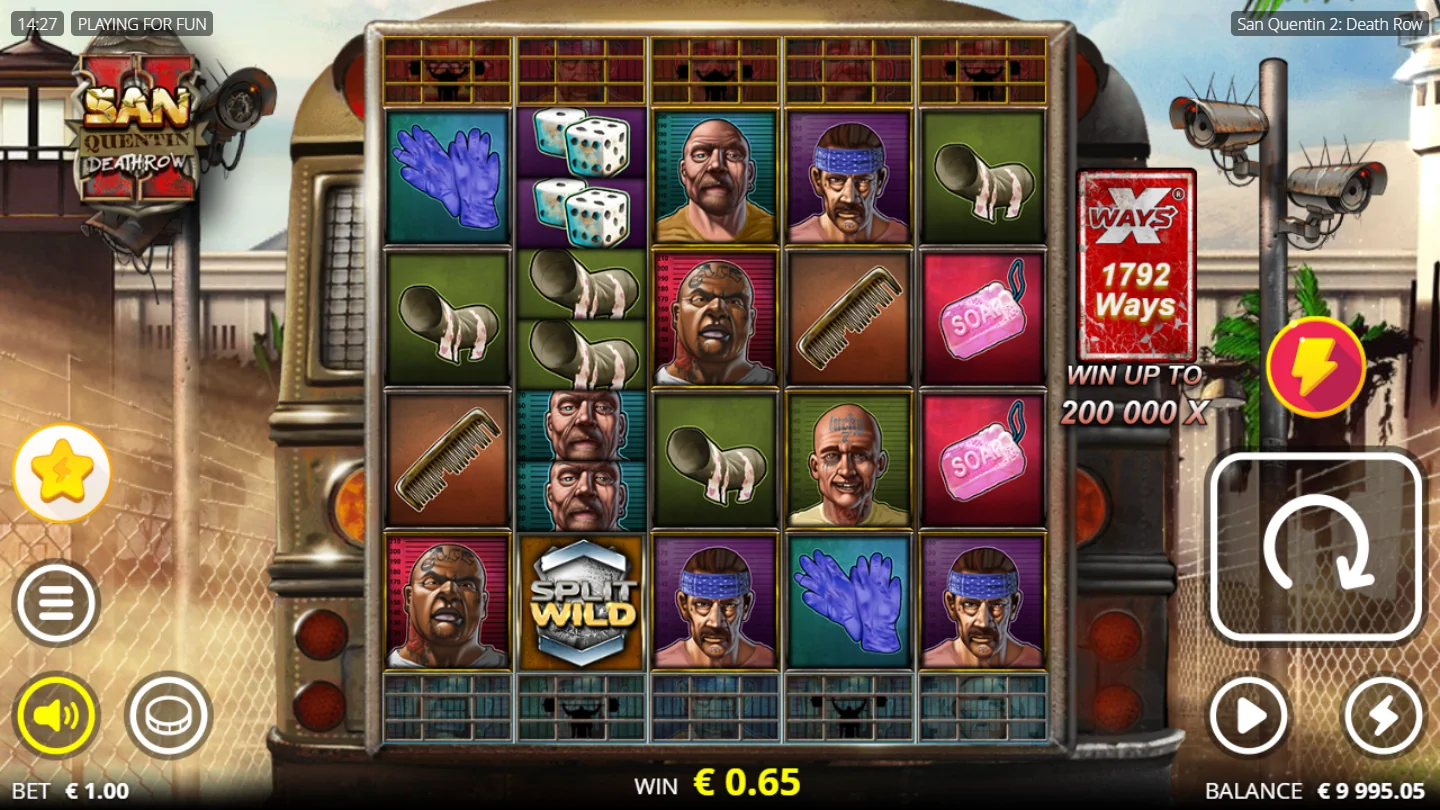
The sixth ordinary round began from a confirmed €9,995.40 balance. Subtracting the €1 stake and adding the €0.65 return gives €9,995.05. That same final balance appears in the settled screenshot. This is a stronger check than reading WIN alone because the complete cost is part of the calculation.
The response fields distinguish stake, payment and state. In the ordinary sample, playedBetValue was one, totalSpinWinnings held the round return and balance supplied the confirmed amount. Both mode and nextMode were NORMAL, with no free spins remaining. Those observations distinguish an ordinary paid start from a child feature action.
| Field | Sixth ordinary round |
|---|---|
| playedBetValue | 1 |
| totalSpinWinnings | 0.65 |
| balance | 9995.05 |
| totalWays | 1792 |
| mode → nextMode | NORMAL → NORMAL |
| freespinsLeft | 0 |
This is an allowlisted explanation of event values, not a full session message. Access tokens and player references are unnecessary for the arithmetic and are not published. A field name is not an instruction to send custom server commands; the recorded actions used the normal game interface.
Actions were sequential on the same connection, with no new paid start before the preceding result. The timing begins with the sent frame and ends with its received reply. It excludes later win animation. A response taking a fraction of a second can therefore precede several seconds of visible splitting or celebration. A mid-animation screenshot may not yet display the final ways count or balance.
These checks establish internal consistency for the small ordinary sample. They do not certify the random generator, prove independence or audit the provider’s entire mathematics. A complete feature would need its initial debit, child actions, retriggers and final balance reconciled together. Our failed purchase did not supply that chain, so no feature-return percentage was calculated.
Any future strategy rule should be fixed before its validation sample and use only information available before each action. Selecting bets after viewing their outcomes would be retrospective selection, not an executable strategy.